Kai 70k (Mount Fuji 100)
Posted by Ed on May 8, 2026
The Mount Fuji 100 is one of Japan’s most iconic and historic ultra-trail events. Initially drawing inspiration from UTMB, the route used to involve a full circumnaviation of Mount Fuji, the 3800m volcano which sits in majestic isolation about 60 miles southwest of Tokyo.
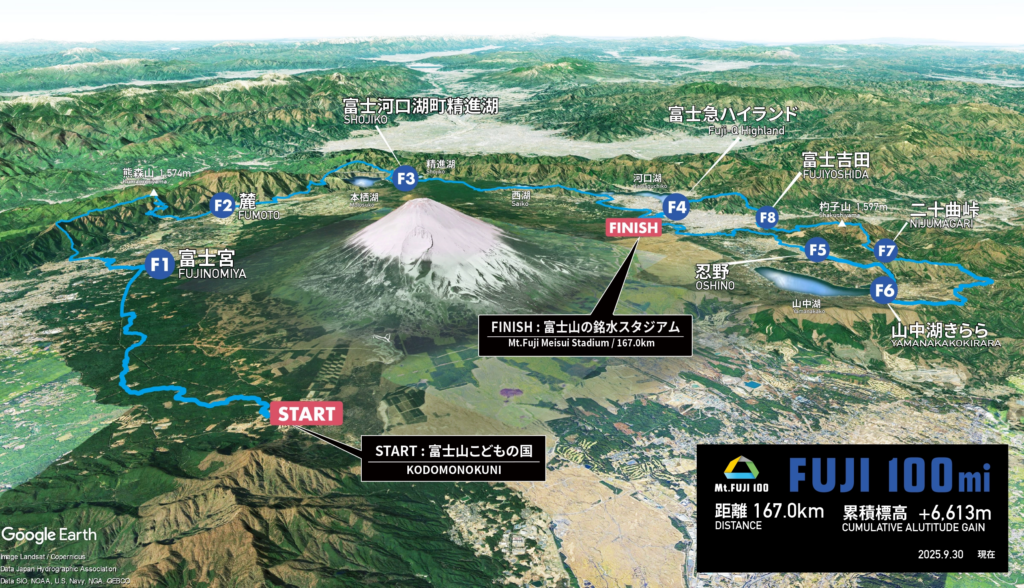
For at least the last couple of years, however, the route has been modified due to landslides on Fuji’s southeastern flank. It is now only a partial circumnavigation, a ‘tadpole’ or lollipop made up of two main segments:
- The ‘stem’: a 90km trip from Kodomonokuni, directly south of the mountain, to Hokoruku athletics park on its northeast flank.
- The ‘head’: a 70km loop from Hokoruku skirting around the edge of Fujiyoshida and heading to lake Yamanakako before returning via a series of mountain peaks and passes.
In addition to the 100-miler, the 70km loop is run as its own race, the Kai 70k (the name ‘Kai’ is a reference to the traditional name of Yamanashi Prefecture, the region in which the race takes place.) There is also the option of the Asumi 40k, a modified version of the Kai race which omits the leg out to Yamanakako.
With over 2000 participants in the 100-miler, the Mt Fuji 100 is, to quote Alphaville, big in Japan. But, despite it being part of the World Trail Majors, it’s relatively difficult to find information about it online from a non-Japanese runner’s perspective. Even less information is available on the Kai 70k, which I took part in. This race report is therefore my attempt to not only record my experience at the event for posterity, but also to hopefully provide foreign runners interested in taking part in this iconic event with some useful insights and recommendations.
I should mention here that in the autumn of last year I picked up an achilles injury which plagued me all the way through until the new year. From essentially zero mileage (and a serious lack of mojo) through November and December I built steadily through January, starting at just 20-30km a week and doing zero speedwork. Slowly but surely I managed to find a decent rhythm, build back some fitness, and regain a love for the sport.
By late March I felt I had done enough to get through the race, which I expected to take me anywhere from 10-13 hours, but my goals going were very much not about performance. I wanted first and foremost to enjoy the experience of racing in a new country and culture, and to rediscover the magic of taking part in a race – particularly one which was likely to be harder, elevation-wise, than any race I’d done before with perhaps the exception of Western States.
In short, in 2025 I got too fixated on performance and lost touch with the adventurous side of running that is ultimately what drew me to the sport in the first place. I wanted to have an adventure at Mount Fuji, and not worry about my time or ranking.
Pre-Race
My partner Emily and I had been planning a trip to Japan for some time before it occured to us that we could build it around this race. Emily was keen to take part in the 40k, so we both entered the ballot via an online portal, RunJapan. Whilst old school, the system was simple enough to navigate, although, in what would become a recognisably Japanese way of doing things, very admin-heavy.
Frustratingly, the results of the ballot were only announced in December – for a race which takes place in April, this felt very late in the day for international runners, who are likely to be planning a holiday around the event and need to book flights and accommodation. Whilst I got into the 70k, unfortunately Emily didn’t get into the 40k, but we knew we wanted to go to Japan anyway, so we booked our flights and began planning our trip.
We arrived in Tokyo eight days ahead of the race, where we spent a couple of jetlagged days enjoying the sometimes overwhelming sights and sounds of Shibuya, Harajuku, and Shinjuku. On Saturday morning we joined Doyou Club in Yoyogi Park for a gentle jog, and later that evening made the most of the numerous incredibly affordable running stores. (Pro-tip for any runners heading to Japan: leave room in your suitcase for apparel and shoes, which are often 30-40% cheaper than in the UK.)
We then took the bullet train to Nagano in central Honshu, where I picked up a pair of waterproof trousers (£35!) which I had forgotten to pack, part of the extensive mandatory kit list for the race. We enjoyed a fantastic hike to the five Togakushi Shrines – well worth checking out – before heading south to spend a few nights unwinding in an traditional onsen resort in Kofu.
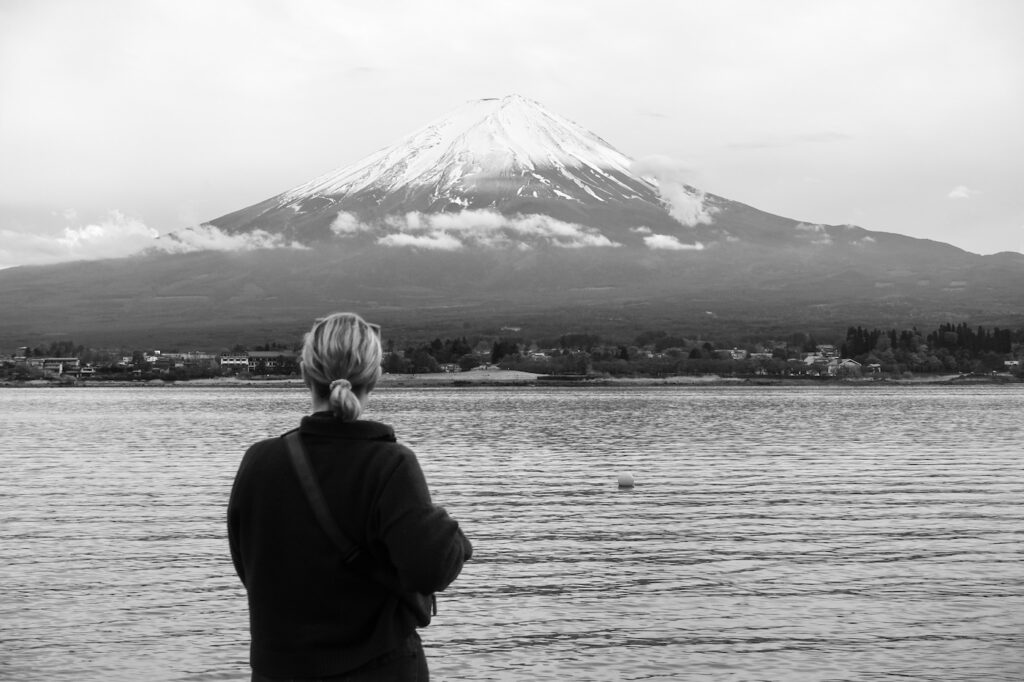
On the train to Fujiyoshida we caught our first glimpse of the Fuji. In a landscape dominated by mountains Fuji truly does stand apart, physically and in terms of its sheer mass, towering a few thousand metres above mountains which are themselves higher than any found in the UK. Wandering around Fujiyoshida, the views of the mountain off in the distance are breathtaking. Its ‘Instagrammability’ has contributed to over-tourism in the town, but whilst we were there it all felt pretty serene. I was pretty relaxed as the race was not due to start until 2pm the next day. We rented some bicycles for the afternoon and cycled to Lake Kawaguchi, before returning to our accommodation and hunting out a pizza meal (a pre-race ritual I couldn’t quite abandon even in a country not renowned for its pizza.)
On race morning we grabbed breakfast in a very trendy coffee house where we met and chatted to Jose, a Peruvian runner also taking on the 70k, and his wife. Emily then headed up to hike Mount Shimoyama via the famous Chureito Pagoda, and I caught the shuttle bus from Fuji station up to the race start in Hokoruku park. Due to the aforementioned Japanese obsession with admin, I hadn’t been able navigate the website for booking a ticket on the shuttle bus (doing so required, among other things, translating your name to phonetic Japanese), but the marshals were very accommodating and assured me I would be able to purchase retroactively one upon arrival at Hokoruku, which proved to be the case.
The race expo was really fantastic, with tons of brands there – many household names here in the UK but also plenty of Japanese brands I’d never seen before. The North Face, who sponsor the race, had decked out two massive tents – one a giant shop full of their latest kit, the other a cafe. Other brands had marquees lining the athletics track, including Hoka, Salomon, NNormal, Petzl, etc. It was hard to resist burning a hole in my wallet, but although I searched around for some gloves (I was a little nervous the thin pair I’d brought wouldn’t be enough) I couldn’t find any and decided to resist buying anything else unnecessarily.
Race registration flowed very smoothly. I think I was in and out in 3 minutes. There was no kit check for me, but I assume these are done randomly as the kit list is very extensive and in poor conditions you would need it all. All I needed to have on me was a QR code that had been emailed to me and some form of identification, which luckily I had remembered to bring.
The 2pm start made it difficult to know what to do for lunch, but I grabbed a coffee and some cookies in the North Face cafe tent and watched the first few runners in the 100-miler cross the line, including men’s winner (and 2025 Western States runner-up) Chris Myers. His 17:50 finish time, having now seen at least some of the course, is truly remarkable, and it tells you a lot about the character of the course – 5000 feet more climbing than Western States, but over three hours slower. More on that later.
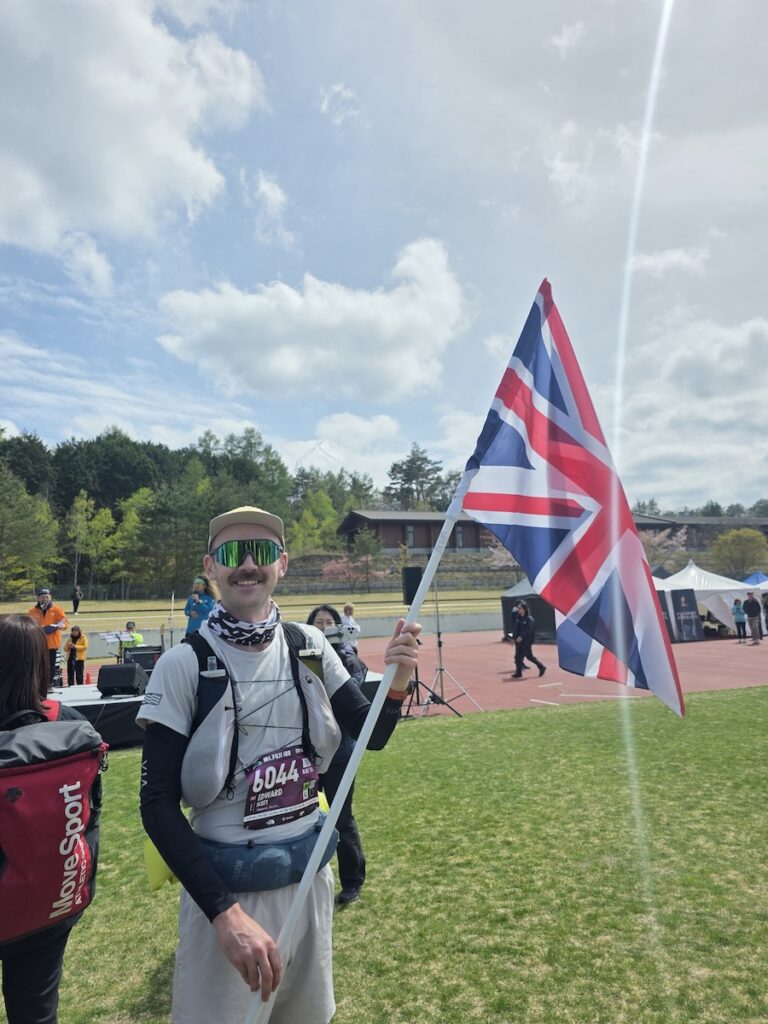
Eventually a crowd began to form around the start and we prepared to begin the race. Flags were handed out for all the nations represented, which was a nice touch, and I managed to grab a picture posing with the Union Jack. Rather brilliantly, we were treated to a musical interlude from a double act featuring an electric guitar and a soprano saxophone, before speeches began introducing the race and the elite athletes taking part. I managed to grab a spot somewhere near the front of the field, which was almost 1000-people deep. Before long, a countdown ensued, and we were off.
The Race
Heading out of the park, the race almost immediately hits a long road descent, which obviously everybody took at a flying pace. I did my best to hold back and settle into a rhythm as I was passed by runner after runner who I had the hunch were going too fast. My pack was quite heavy, not only with the mandatory kit but carrying all the nutrition I needed for the race, as I didn’t want to take my chances on Japanese products at the aid stations I’d never treid before. Even going conservatively, I passed through the 5k mark in under 27 minutes – the fastest I’d run that split for the rest of the day!
The long road helped spread the crowd out a little bit, although when we hit the first short climb a queue quickly formed. In our midst almost immediately were 100-mile runners, who by this point had been on their feet for upwards of 20 hours and were staring down the barrel of another 70km. The first climb gave us a little taste of what was to come, climbing about 70 metres in just half a kilometre and often hitting gradients of 25% or more. Again, I took it easy and tried to find my flow.
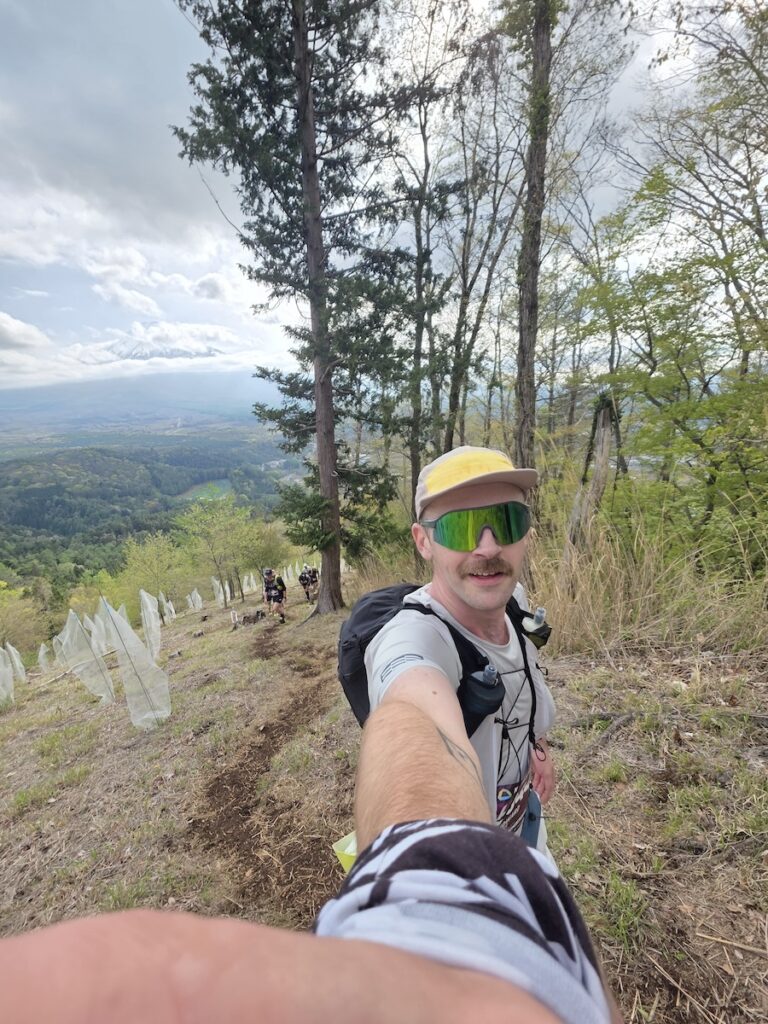
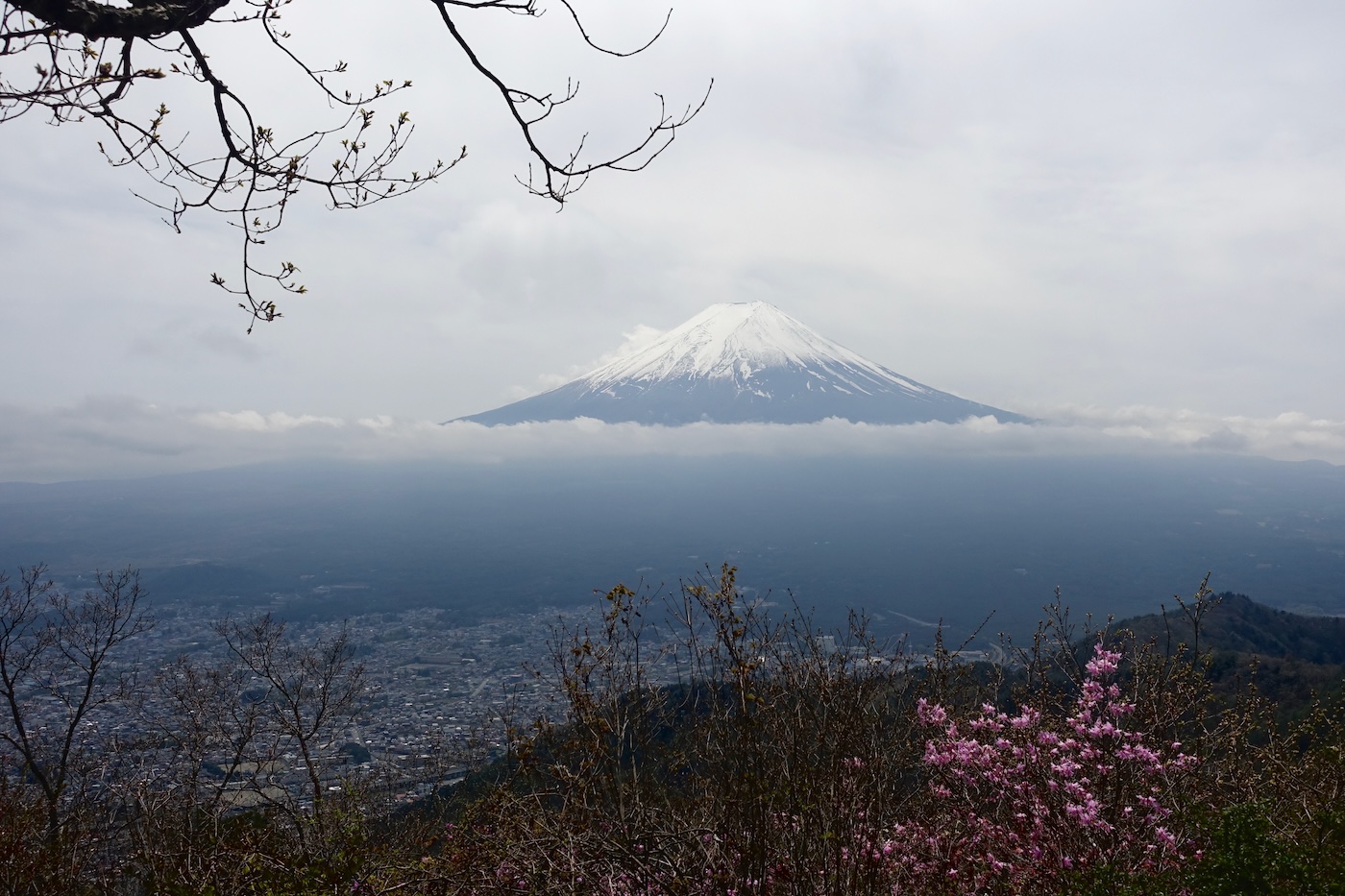
Dropping off the other side, we once again hit the road and skirted around the edge of Fujiyoshida before the first proper climb up to 1000m, where we were treated to spectacular views of Fuji in the distance. Later in the day, cloud coverage and then nightfall would hide it from view, but on this early section we got to really enjoy it and I snapped a few pictures on the way up. I passed Jose on this section, who was doing an amazing job of cheering each and every 100-mile runner we encountered. The contrast between his Peruvian enthusiasm and the introversion of the Japanese runners was funny to observe, but it was a real reminder of how lucky we are to be part of a truly global sport with a shared passion for wild places.
After a long descent I arrived at the first aid station in Oshino. I topped up my water and drank an extra bottle, but didn’t touch any of the nutrition on offer. I was in and out, according to the official results, in less than three minutes. There then followed a rather tedious 3.5km sretch on a long, straight road through some rice fields. The subtly uphill gradient combined with my heavy pack made this slow-going, but I tried to make the most of the opportunity to bank some easier, albeit less scenic, miles.
After a 300m climb to the summit of Hiraofuji, where some very enthusiastic marshals awaited us (rubber chickens appear to be a recurrent theme for cheer squads in Japan), we enjoyed a really lovely descent down to Hirano, the village sitting on the shore of Lake Yamanaka, another iconic Fuji viewpoint. Again, the marshals and cheer squads were brilliant here – I spotted one guy dressed in a full hot dog costume waving runners in. The aid station was in some kind of community centre, with lots of tourists and supporters out and about, which always makes for a nice contrast from the isolated stretches you experience in ultras like this one.
Again, I made quick work of this aid station – the data says I was out in five minutes – heading out as the first signs of sunset began to appear: a slight chill in the air, the light softening. The next climb up Teppouginotō was largely exposed, giving us views of the lake behind us as we ascended. This section was the most familiar to me, the open grassland somewhat reminscent of British hills, although the final stretch up to the summit, atop which sat a small shrine, was exceptionally steep. A marshal clad in a Yoshi hat kindly offered to take my picture.
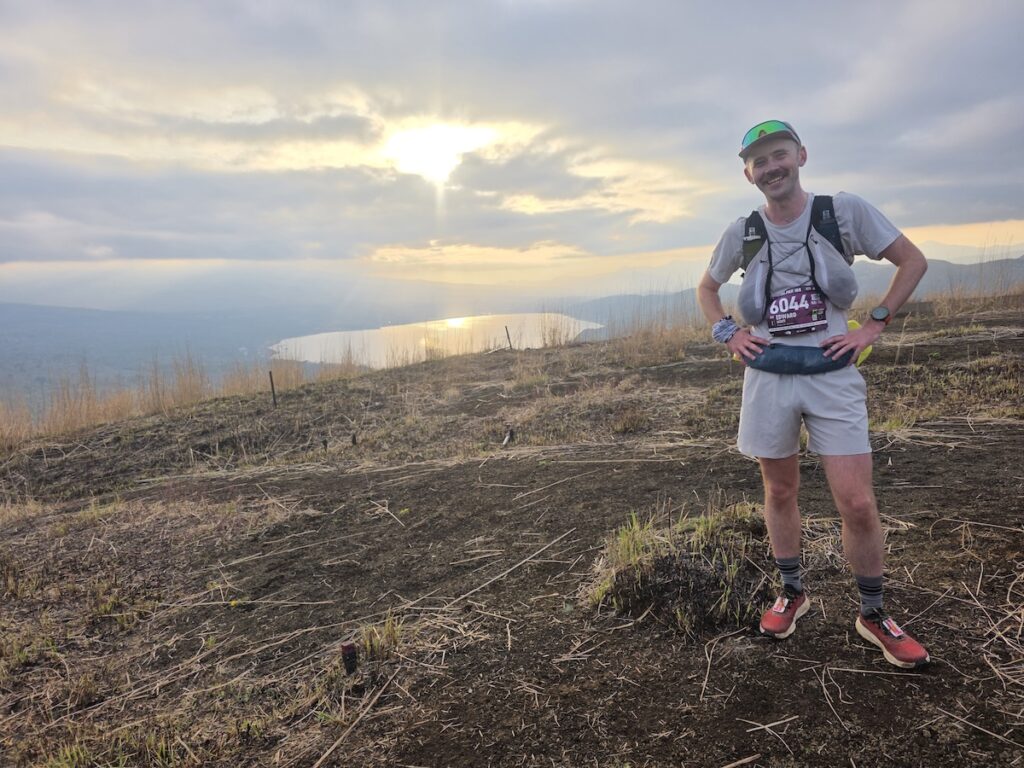
By this point I was feeling pretty good. I’d made decent time through the first 28km of the race, hitting the summit of Teppouginotō in just over three and a half hours, and felt like, if it carried on like this, I had a solid chance of dipping under 10 hours. The descent off the summit, though, gave me a little taste of the carnage that was to follow. Steep, technical descents are a real weak spot for me. It’s partially a psychological thing – I’m just more of an ‘uphill’ kind of runner – but also there isn’t much opportunity to practice such descents here in the southeast of England. My final long run before the race had consisted of a series of climbs and descents along the escarpment of the North Downs, but although the elevation gain/loss on that run was significant, the climbs and descents are just nowhere near as long as those you find in the mountains.
Humbled by the flurry middle-aged runners who made light work of the downhill and passed me (including, embarassingly, a couple of 100-milers), I made it to the bottom in one piece. I brushed off my ego as I passed most of them back on another long, flat stretch back through the outskirts of Hirano. The course had been diverted here following a landslide a few weeks ahead of the race. Instead of following the ridgeline around the town, we instead had to drop back down into the ‘bowl’ and climb out the other side.
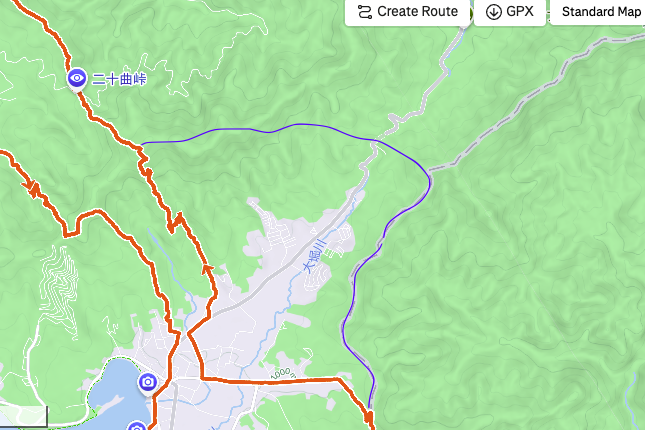
It was a shame to have to spend more time on the road, although it undoubtedly sped things up, shortening the race by around 1km and actually reducing the amount of climbing we had to do. The climb back out the other side to Mount Ishiwari, though, as you might be able to tell from the squiggly line above, was exceptionally steep. Indeed, this was the first of multiple “WTF” moments that I experienced in the latter half of this race. The Japanese apparently don’t do switchbacks. Rough wooden staircases were embedded into the singletrack trail, which was cut up by roots and rocks every few metres. We climbed about 400m in 2km. A saving grace was the remote Ishiwari Shrine, which sat in quiet isolation on the hillside. A moment of stillness in the suffering.
It’s funny – at the time, all I could really focus on was how steep the climb was. Now, back in the safety of home, I find myself nostalgic for the solitude, the grit, the peacefulness of the forest. Ultras are weird like that. They can suck at the time but you miss it once it’s over.
Somewhere on the climb up Ishiwari we passed through the halfway point of the race. I clocked 4:30 on my watch and felt like sub-10 was still very much on the cards. This was also where the headtorches came on as the sun, whilst not fully set, was fully obscured by the forest. Another rough, though blessedly short, descent took us to the Sora No Iro aid station, which although only 38km in was the penultimate pitstop of the race. I took a bit more time here to get myself in order. I felt like, despite how difficult I was finding the terrain, I was doing a good job managing my nutrition, and the aid stations were a big part of that. I made sure to top up all my water and drink an extra bottle, and here I treated myself to a bit of coke.
One helpful thing at this race was that English-speaking marshals wore special yellow gilets with INTERPRETOR written on them. Generally the level of English across Japan is pretty low – people can say hello, thank you, yes, no, etc. but it’s impossible to have a proper conversation and you have to rely on a combination of miming, pointing, and Google Translate. This meant I’d spent much of the race not really talking to anybody (there were a few westerners but I didnt spot any other UK bibs) beyond a simple arigato gozaimasu. To be met mid-race, then, with a fully fluent English speaker was quite a refreshing experience. He offered me some words of support and explained the profile of the next part of the course (one massive climb, one massive descent, another massive climb, another massive descent, and then a runnable uphill 5k to the finish), and sent me on my way. I left (to the sound of the Rocky theme tune being played by the same saxophonist who had been at the start) feeling encouraged and confident about closing this thing out.
The climb out of this aid station, to the summit of Shakushiyama, was frankly horrendous. Although it was only a 400m ascent, it compressed that elevation gain into 1.5km, meaning at times the gradient (according to my Strava file) exceded 50%. This doesn’t really do it justice, though, as it wasn’t so much the steepness but the technicality that made it so slow-going (at one point I clocked a 25-minute kilometre.) After a stretch of trail, the route gave way to a series of low-grade scrambles leading up to the summit, complete with ropes to pull on for support. On more than one occasion I had to stop as my legs cramped up, I think because I just wasn’t use to extending my hip flexors that far to get purchase. Despite this, I felt like I was faring better than most of the people around me, and I passed quite a few going up, although a few of them were likely 100-mile runners.
After what felt like an age, we reached the highest point of the race, around 1650m, at exactly the marathon mark. Beginning the downhill, which whilst not quite as ‘scrambly’ was in places just as steep and technical, I watched my sub-10 hour dreams turn to dust. The 8km descent took me an hour and a half – for most of it I was gripping to ropes and trees to maintain balance (the race does not allow poles, which would have been super useful on this stretch.) Whilst I once again struggled on the steep stuff, when it finally gave way to a series of switchbacks I was surprised to find that I still had decent running legs, and I made an effort to maintain a decent clip where I could.
Back in Fujiyoshida for the final aid station, I tried not to get too carried away with thinking the worst was behind me. The final stretch between Fujiyoshida aid station and the finish is almost 19km, which felt excessive, especially for 100-mile runners. I downed another can of coke at the aid station and topped up my supplies, opting not to try out the noodles for which the aid station was apparently famous – nothing new on race day, etc. I headed out through the streets of Fujiyoshida, the town very much asleep at this point. Again, a there was a long stretch of flat road running here – almost 5km by my watch – for which I was, at this point, quite grateful, as it gave me a chance to claw back some time. At one point a marshal manning a small road crossing made me wait for a green light, despite there being literally zero cars in view – such is the Japanese way.
By the time we reached the bottom of the final climb, there was only 14km to go, a distance which felt psychologically manageable. But, whilst not as heart-stopping as the Shakushi climb, the climb up Mount Shimoyama was by far the longest. 700m of ascent in around 4km, all largely on a winding, non-technical singletrack. I felt like I was moving well, passing multiple groups of runners, although I did dabble with a few small pity parties as the climb just felt like it was never going to end. According to Strava it took me about an hour to reach the top – the same summit Emily had hiked earlier in the day. But where she had been treated to a fantastic view of Fuji, all we had to gaze out at were the lights of Fujiyoshida, 700m below us.
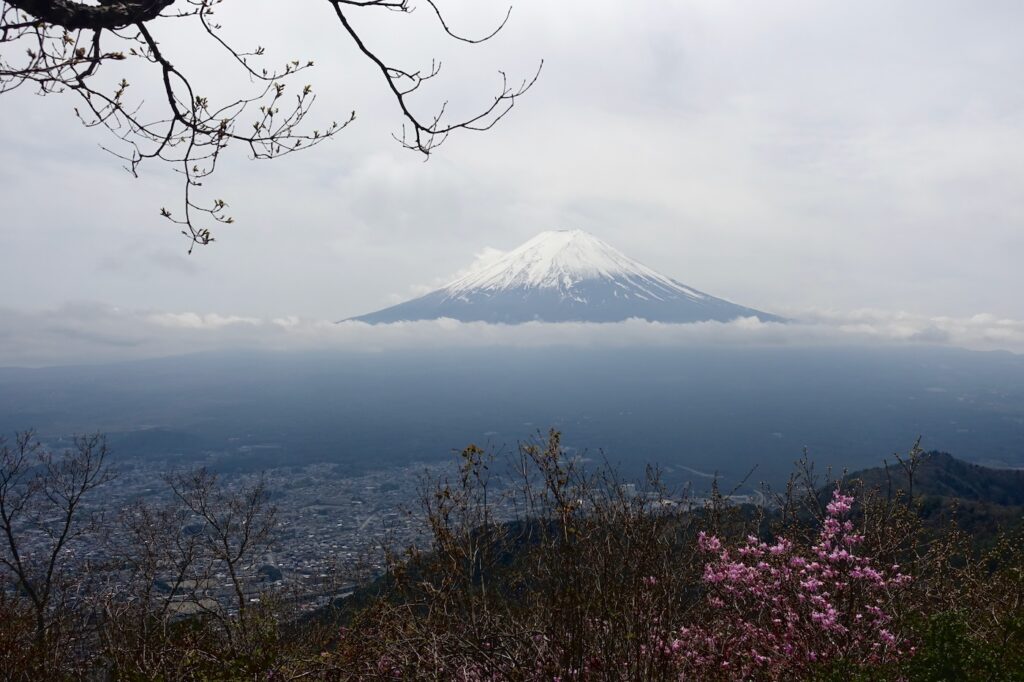
Knowing all the serious climbing was now behind me was gratifying, but by this point I had become more anxious about the descents than the uphills. Luckily, the descent from Shimoyama, whilst occasionally veering into 30+% grades, was largely manageable, and I managed not to let out too many curse words as I once again gripped ropes and trees to pick my way down. 45 minutes or so later, I finally hit the road back into Fujiyoshida, where I was able to break out into a run as we skirted around the outskirts of the Fuji-Q Highland theme park. Passing underneath a dormant rollercoaster certainly made for a unique way to finish.
The final 5km of the race, as I mentioned, is on a gentle uphill gradient, around 2%. This felt like a bit of a kick in the teeth, but really it played to my strengths as a lowlander. My 10-hour goal having passed, but with sub-11 very much secure, I allowed myself to alternate between a gentle jog and a walk, not feeling any real desire to ‘grit it out’. I wanted to savour the experience and reward myself for having gotten through some of the toughest hours of trail running I’ve ever gone through.
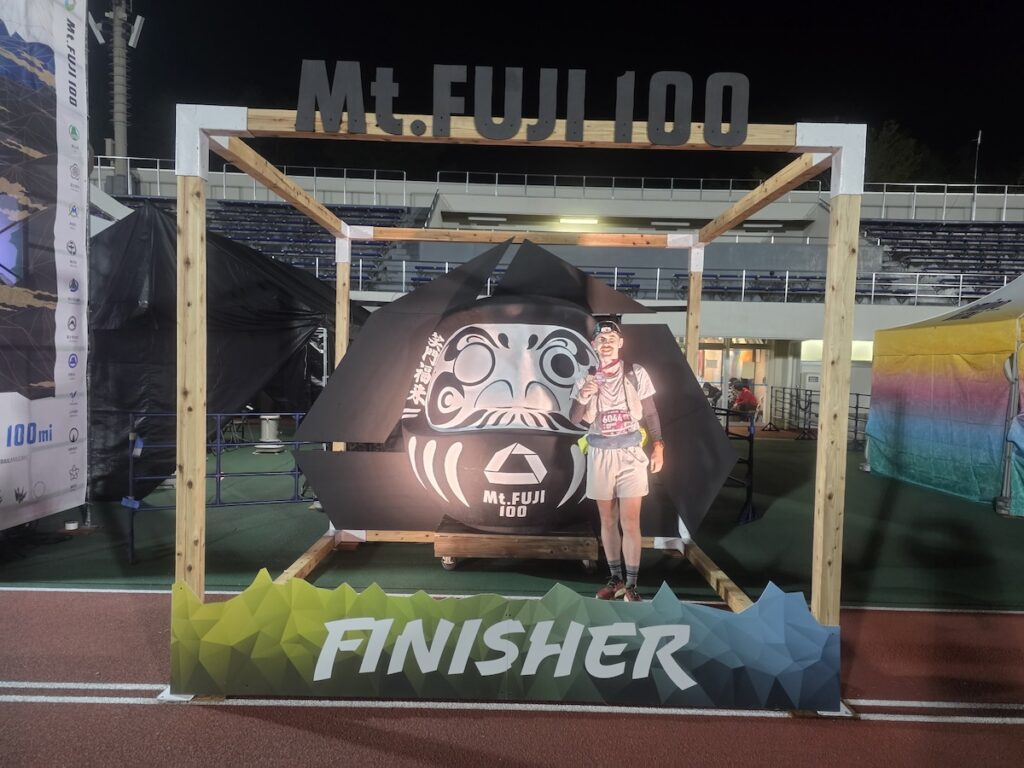
Eventually, the trail gave way to road, and before I knew it I was back in the grounds of Hokoruku park, crossing the finish line in 10:39:05. Some way off my initial sub-10 goal, but still good enough to finish just outside the top 100 in a race with 992 starters. So not awful.
Post-Race
After collecting my medal and picking up my bag, I made use of the changing facilities to get back into some warm clothes before picking up a slice of pizza. Midway through eating it, I was overcome by a wave of nausea and intense feeling of being too warm – I had to go outside and lie down on the floor for a few minutes. I’ve felt pretty gross after races in the past, but I’ve never experienced this particular feeling before. Thankfully, though, it passed, and I was able to hobble my way to the shuttle bus which took me and a bunch of other exhausted looking runners back into town. I walked the 30 minutes back to our accommodation through the quiet streets of Fujiyoshida, feeling like I had got what I came for: a proper adventure.
I was a bit sore for a few days after the race, but nothing too terrible. I think the fact that I had more or less managed to sustain 90g of carbs an hour, and taken on enough water and electrolytes, meant that although my muscles had worked hard on all the steep gradients, I wasn’t too beaten up internally. The day after finishing (or, rather, the same day, as I finished at 12:30AM), we travelled to Kyoto, and I felt fresh enough to navigate that journey relatively stress-free, albeit exhausted.
I would definitely recommend this race to anyone looking to step outside their comfort zone and experience the Japanese trail running scene. It’s a proper marquee event with thousands of runners, but aside from the opening miles it never felt too crowded. As anyone who has travelled to Japan will know, the country has a unique personality. The Japanese way of doing things is defined by, on the one hand, a cultural obsession with precision, technology, and tidiness, and on the other, a deeply rooted respect for tradition, hierarchy, and the status quo. ‘Highly precise and highly traditional’ is probably the best way of describing it.
This race reflected that: it had all the comforts of a modern well-organised event, with well-stocked aid stations, clear course markings, friendly and informed marshals; but also a special feeling, unique to Japan, of deep history and a sacred landscape. That’s what makes it such an iconic event and a valuable member of the World Trail Majors series. I never felt like a number, and although I had limited opportunity to speak with fellow runners, there was a shared sense of being on an epic journey together.
2 comments on "Kai 70k (Mount Fuji 100)"
Paul Vining
May 9, 2026 at 7:38 pm
Great writeup, I think I am inspired to sign up for 2027 🙂
Ed
July 21, 2026 at 10:17 am
Thanks Paul! Hope you do. It’s a great event.
Comments are closed.