London Loop FKT Debrief
Posted by Ed on September 23, 2026
Please consider donating to my fundraiser for TrailFam, a charity working to improve the lives of young people through the sport of trail running.
You can listen to a podcast debrief of this FKT here.
“To observe the city edge is to observe an amphibian. End of trees, beginning of roofs, end of grass, beginning of paving stones, end of ploughed fields, beginning of shops, the end of the beaten track, the beginning of the passions, the end of the murmur of things divine, the beginning of the noise of humankind.”
Victor Hugo
Earlier this month, with the help of a crack team of crew and pacers, I managed to set a new fastest known time, or ‘FKT’, running the London Loop, a 150-mile waymarked route that circumnavigates London.
This was a project I’d been building up to for the best part of a decade. I first started running in 2016, fresh out of university and back living with my parents in Bushey, on the Hertfordshire border with north west London. Beyond weekly swimming lessons and the odd bit of tennis growing up, I’d never done any kind of structured sport. I was more into the clarinet. But for some reason running quickly clicked for me and I soon found myself drawn to the trails.
I got hooked on finding and exploring green spaces close to home that I never knew existed, and before long I stumbled upon signs for the London Loop in nearby Bentley Priory and Harrow Weald Common. A little bit of googling revealed that this slither of trail was part of a much bigger route, and the seed was planted.
Despite the borders having been clearly defined over 60 years ago, the question of where London stops remains an ambiguous one for many of the city’s 9.1 million residents. London is hemmed in by the Metropolitan Green Belt, a patchwork of protected green spaces designed to prevent urban sprawl. But it’s not like one second you’re in the concrete jungle, the next in open fields of wheat; in every direction, the city splutters slowly to a standstill, its tendrils curling into the surrounding counties like ivy in a terrarium.
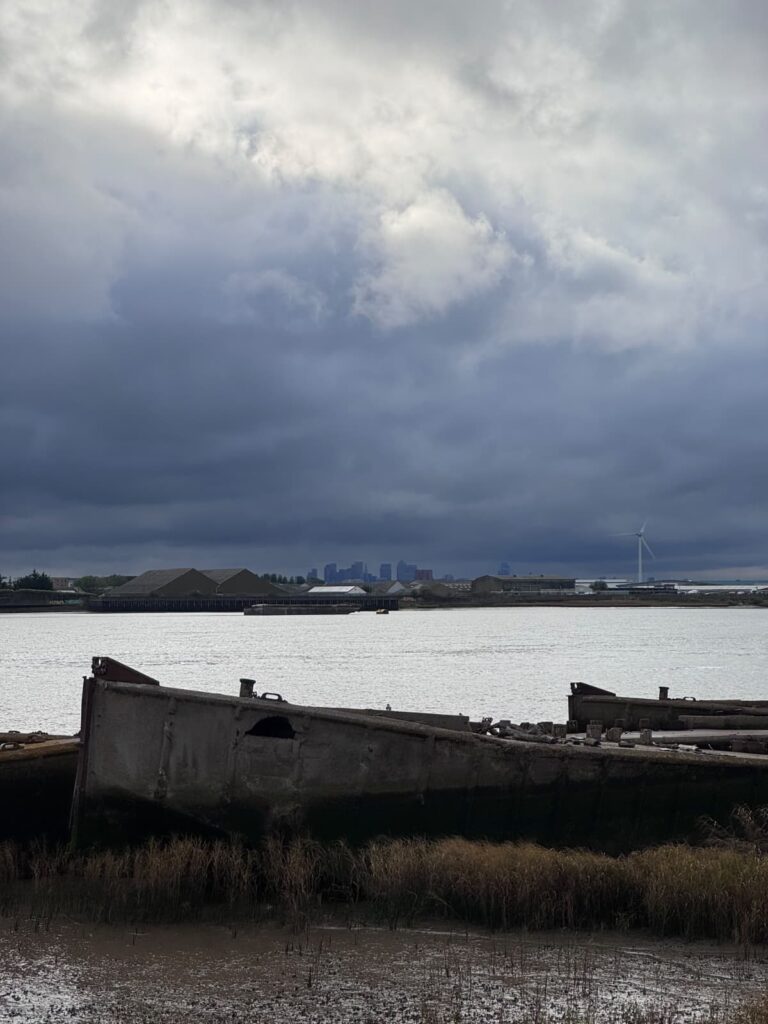
Nowhere is this in-between-ness more obvious than on the London Loop. The route does not traverse the kind of landscape you might picture in your head when you think of London. Instead, it winds its way around the fringes of the city. A suburban park gives way to a pocket of ancient woodland, a back alley leads to open fields by the side of a main road. Traffic is never out of earshot.
My Loop attempt starts on a sunny Saturday morning at Erith station. Erith is a strange place. East of Woolwich (if you can imagine such a thing) and home to the city’s longest pier, the wide Thames estuary almost lends it a seaside feel. Within a few miles, we’re running along the salt marshes that flank the town, looking out at ponies grazing against the clattering backdrop of heavy industry. The distant Dartford Crossing looms into view. It feels more like Chernobyl than Chichester.
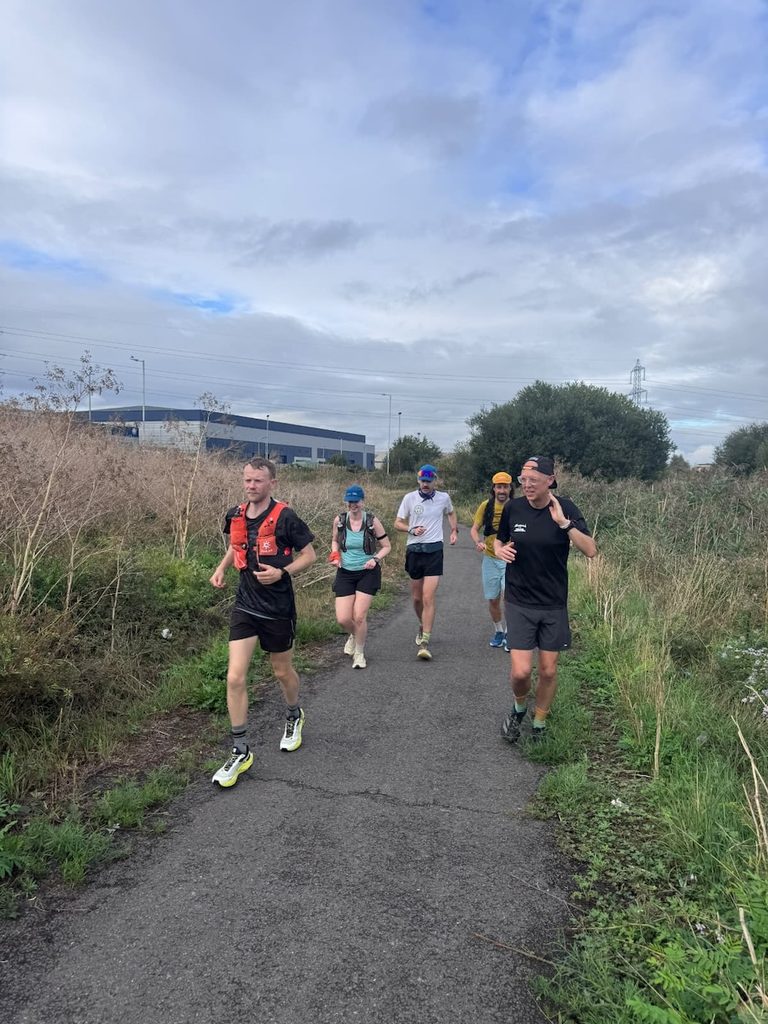
I’ve elected to take this FKT on ‘Supported’, which means I can have as much help as I like. Along the way, at different stages, people will meet me to carry everything I need. All I have to do is put one foot in front of the other. On this leg, Chris, Michael, and Noemie keep me company. I’ve built a comprehensive pacing plan targeting a sub-33 hour finish, but I’d be happy with any time under the existing record of 34 hours and 23 minutes.
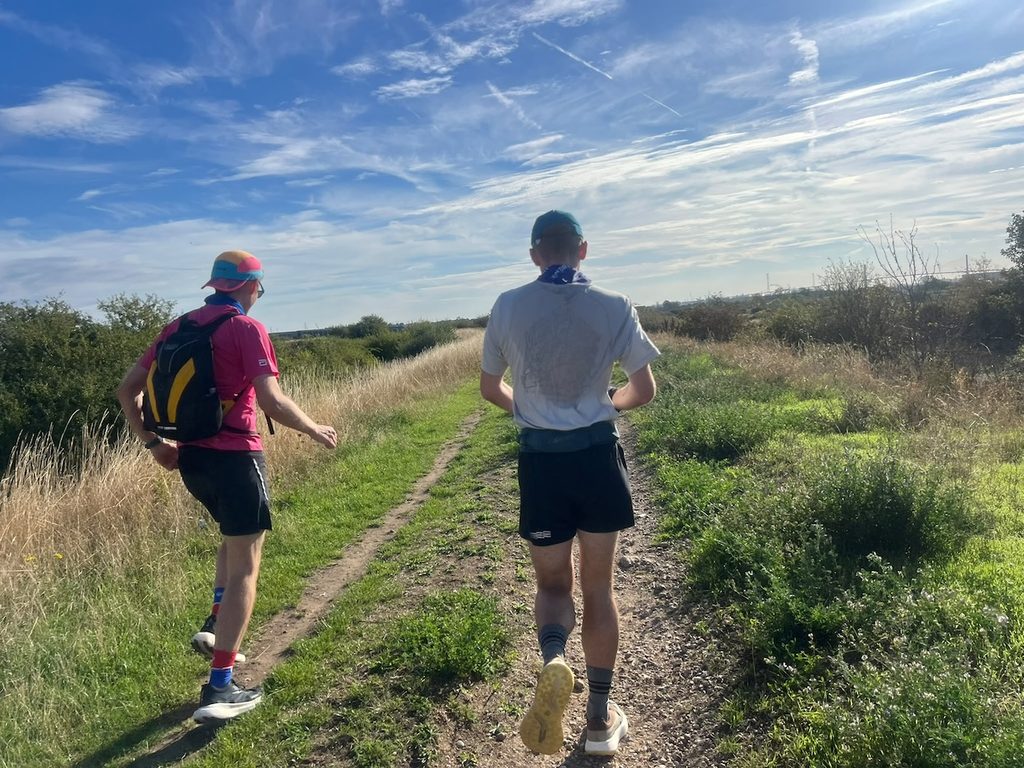
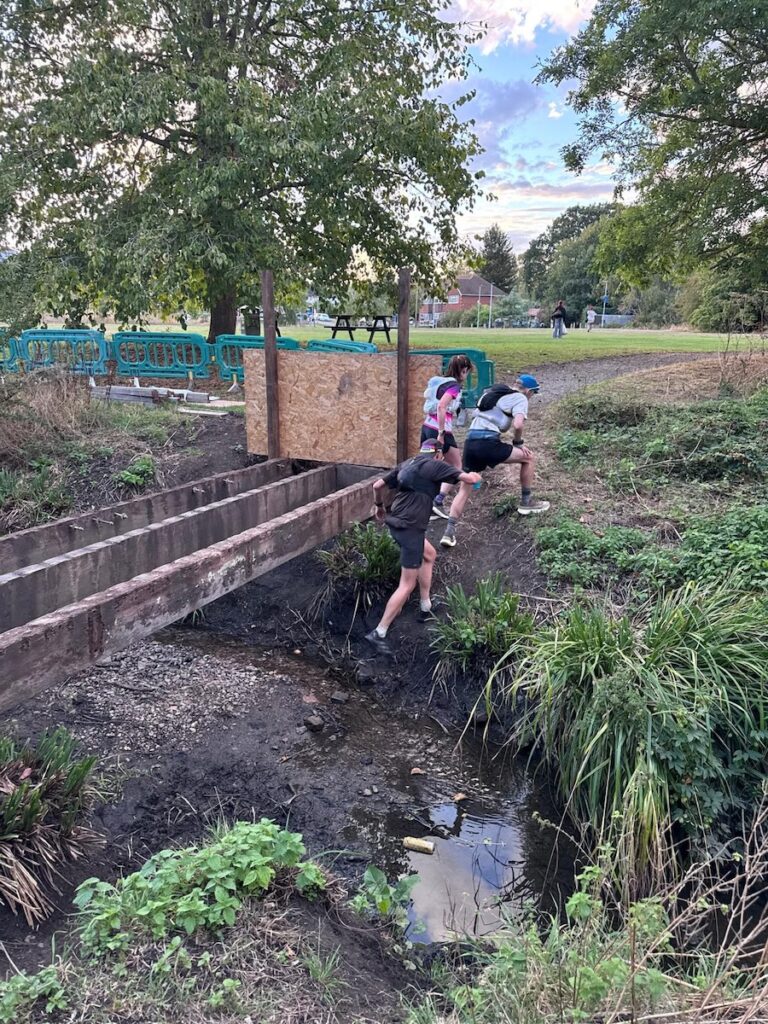
Before long we leave the marshes behind and climb slowly upstream against the Cray River. We enter a section of the Loop defined by the North Downs, a ridge of chalk hills running east-to-west directly south of London. Whilst we’ll never crest the ridge, we must traverse a series of dry valleys that fall away from it towards the city. This is the Loop’s hilliest section, and I’ve budgeted more time for it. At Orpington my pacers hand over to Henry, Laura, and Richard, and we meet my partner Emily with the car for a crew stop. Spirits are high and I’m moving well, but I have to keep reminding myself we are only 10% through this thing.
The heat of the day begins to set in, rising to a modest but noticeable 23 degrees Celsius. A bandana filled with ice around my neck does a good job of keeping my core temperature down, but my heart rate rises nonetheless on the steeper climbs. Thankfully, this is a truly beautiful section, with miles of gorgeous trail to keep me distracted. If you’re looking to explore the Loop for yourself, I’d highly recommend running or hiking this stretch from Petts Wood to Coulsdon.
When we meet Emily for the second time at Farthing Downs, we are a quarter of the way through, and a good 15 minutes ahead of schedule. Jules, Aurime, and Andy hop in for the next leg, a largely suburban section through southwest London and towards the river again. We cross the bridge at Kingston just as the sun is beginning to set. By now we are half an hour ahead of schedule, but I’m beginning to feel the fatigue. I have to remind myself that 55 miles is already a long way to run, and it’s no surprise that my legs are already hurting. I hastily compartmentalise all thoughts of the 95 miles to come.
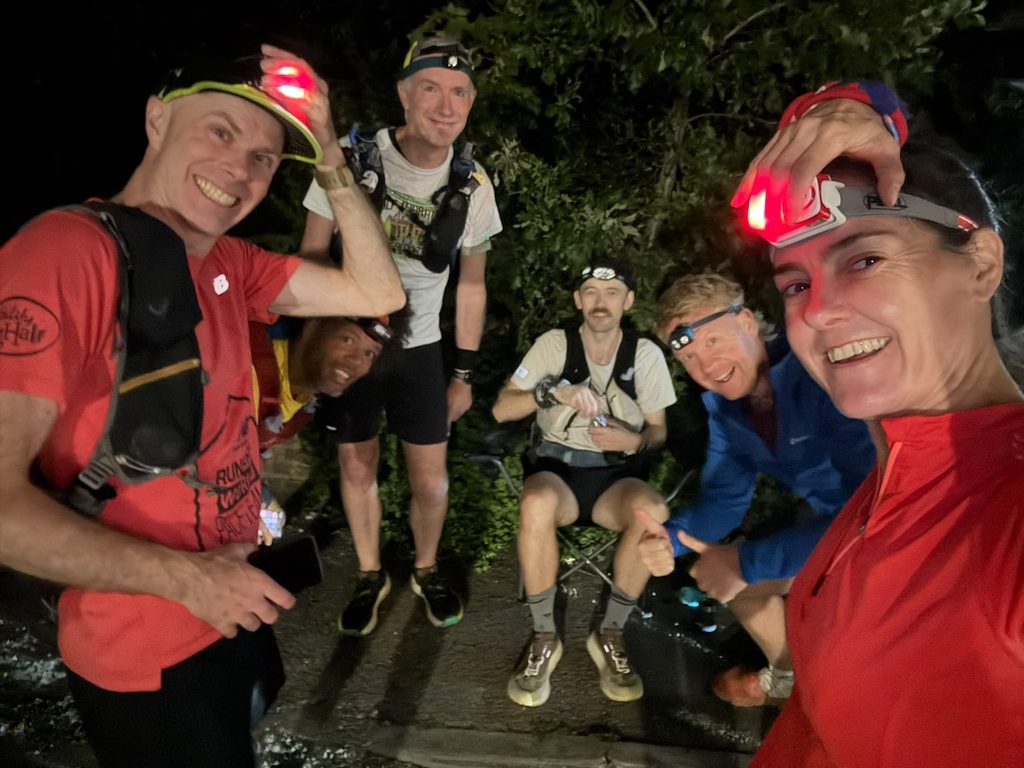
Richard and Anna – two elite ultrarunners in their own right – pace me through the next 20 miles by the light of our headtorches. We pick our way through Bushy Park, the Heathrow flight path drawing ever nearer until planes are screaming a few hundred metres directly above our heads. Soon we join the Grand Union Canal, and I brace myself for the relentless flat. You might think it’s a relief, but with 100km in the legs, I crave any opportunity to take a walking break. With no hills, Richard and Anna do a good job of delivering the tough love I had asked for: it’s runnable, so we run. Slowly.
At Uxbridge we meet Spencer, my second crew driver who has selflessly volunteered for the night shift. We pass the halfway mark in 14 hours and 40 minutes, giving me just under 20 hours to complete the remaining 75 miles. Despite a few wobbles spirits are still largely high. I try to sip some coffee, but it’s too hot, so I make the mistake of not bothering. Over the course of the next leg, paced by Mark and Ali, this lack of caffeine begins to take its toll. It’s past midnight now, and although we’re traversing a section of trail close to where I grew up, I’m struggling to figure out where I am. It’s not until we hit Oxhey Woods that I begin to get my bearings, by which time the heavens have opened and we are caught in a surprise downpour.
It’s a mild night, so although we get a soaking, nobody is in danger. But my wet clothes, and in particular my wet feet, induce a sense of humour failure. When we lose sight of the trail in some dense undergrowth a few miles out from our next crew stop, it’s all I can do to keep myself together.
We meet Spencer again at the Warren Lane car park in Stanmore, which is strangely busy for 3AM on a Sunday. This crew location has been the subject of much discussion in the WhatsApp chat during the build-up to the run. The general consensus seems to be that there is a non-zero chance we’ll witness some dogging. It’s a relief, then, that the only person taking their clothes off is me, as I change out of my wet socks and T-shirt. My feet appear to be in decent shape, perhaps thanks to the gallon of lubricant I applied to them before setting off.
I’m joined for the next leg by Kris and Rich. This is a particularly poignant moment, as Rich had a go at the Loop himself back in June to celebrate his 40th birthday. Regrettably, although he finished, he came up short of the record, largely because he took it on during a heatwave. Part of the reason I’ve gone for a September attempt is to avoid this risk, although the long night has presented challenges of its own.
A series of landmark moments then pass in quick succession: we hit the 100-mile mark, 20 hours and 30 minutes since starting, and Kris marks the occasion with a couple of pre-prepared voice notes for me from friends, family, and even celebrity ultrarunner Lucy Bartholomew; then, very slowly, the navy sky begins to lighten. I’m hurting, but thankfully I don’t feel sleepy. In fact, I feel quite chipper, which should really be a sign to watch out: pride always comes before a fall.
At Cockfosters, closing in on 200km, we meet Dan and Keijo, who join me for another scenic leg through Trent Park and Enfield Chase. Initially buoyed by the brief rest and change of pacers (and a double espresso), my spirits soon unravel, and I’m unable to grasp how I’m possibly going to carry on. Dan encourages me to keep moving and, crucially, to keep eating, but my knees are flaring up and my legs feel like two stumps underneath me. It doesn’t help that this leg is largely downhill, the impact on my quads growing harsher with every step.
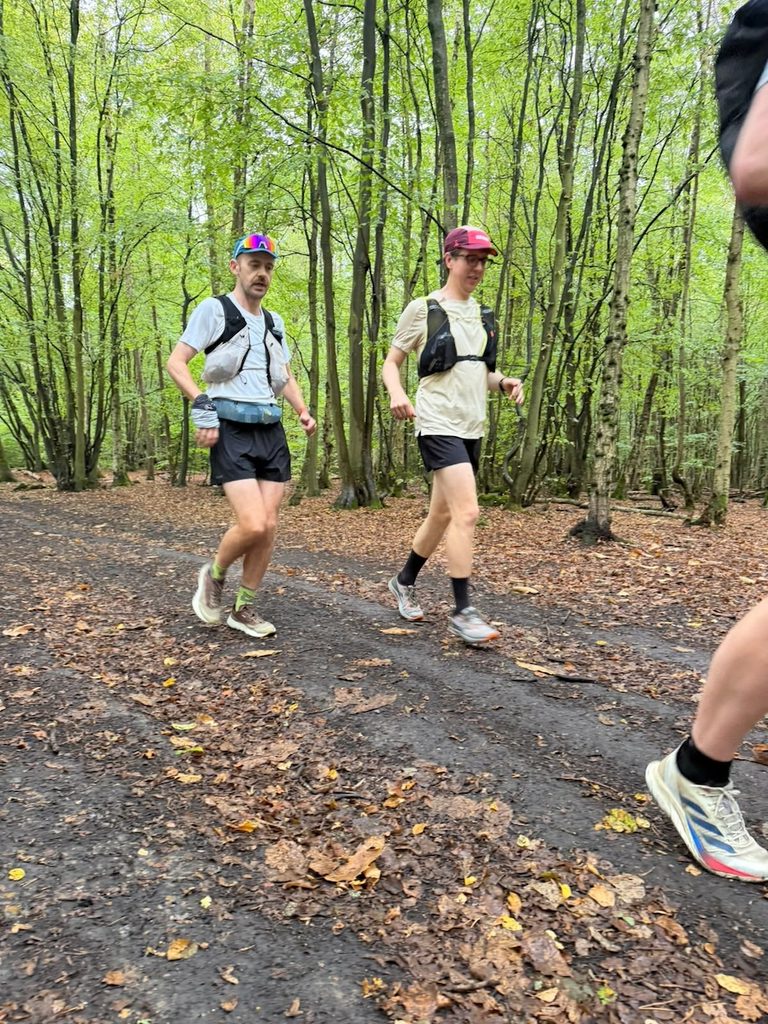
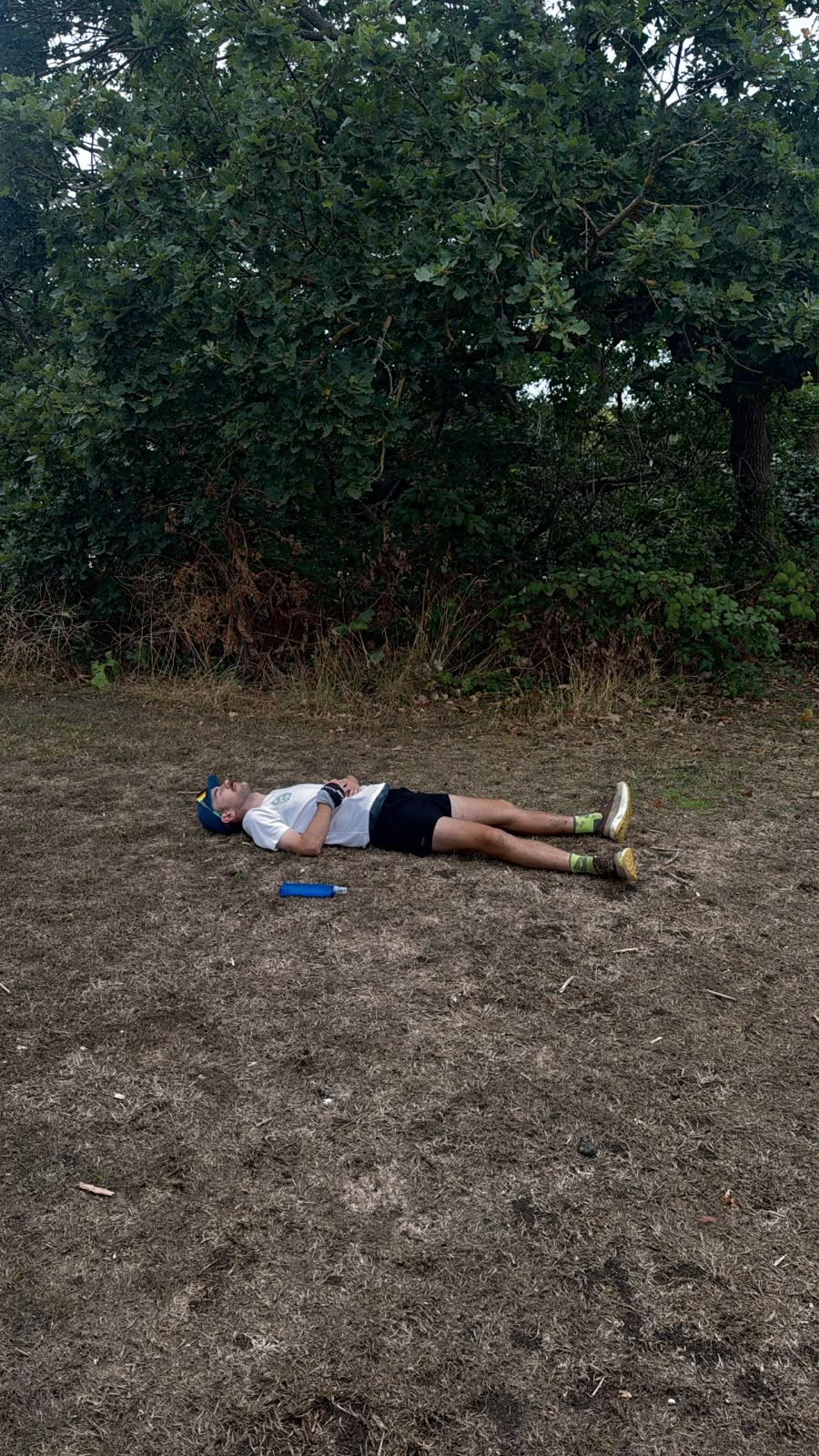
Leaving Epping Forest, something has to give. I lie down onto a patch of grass and ask for a two-minute time check. It’s a relief beyond description to simply shut my eyes and take the weight off my feet. Within seconds my mind drifts in a state of half-sleep, and I briefly contemplate pulling the plug and staying here on the grass. But soon Dan is telling me to get a move on, and I force myself up.
When we reach Spencer again at Chigwell, the 30-minute lead I’d eked out over the course of the first 50 miles is largely gone, but we are still on-pace for a sub-33 hour finish. I spend the entire 10 minutes I’d budgeted for this crew stop lying down again, my eyes shut. At one point I completely forget what is going on. It’s bliss.
Alex and Patrick take the reins for the final push. As we set off, again I’m overwhelmed, unable to comprehend how I’m going to finish. My knees are completely locked up and my feet now feel like they’re in a vicegrip. Alex tells me to just keep walking and wait for the coffee and painkillers to kick in. They do, and miraculously I not only start running but actually begin to enjoy myself again. Passing by the giant redwoods in Havering Country Park, Alex regales me with stories of his recent third place finish at UTMR, and slowly I begin to entertain the notion that this thing might actually be over soon.
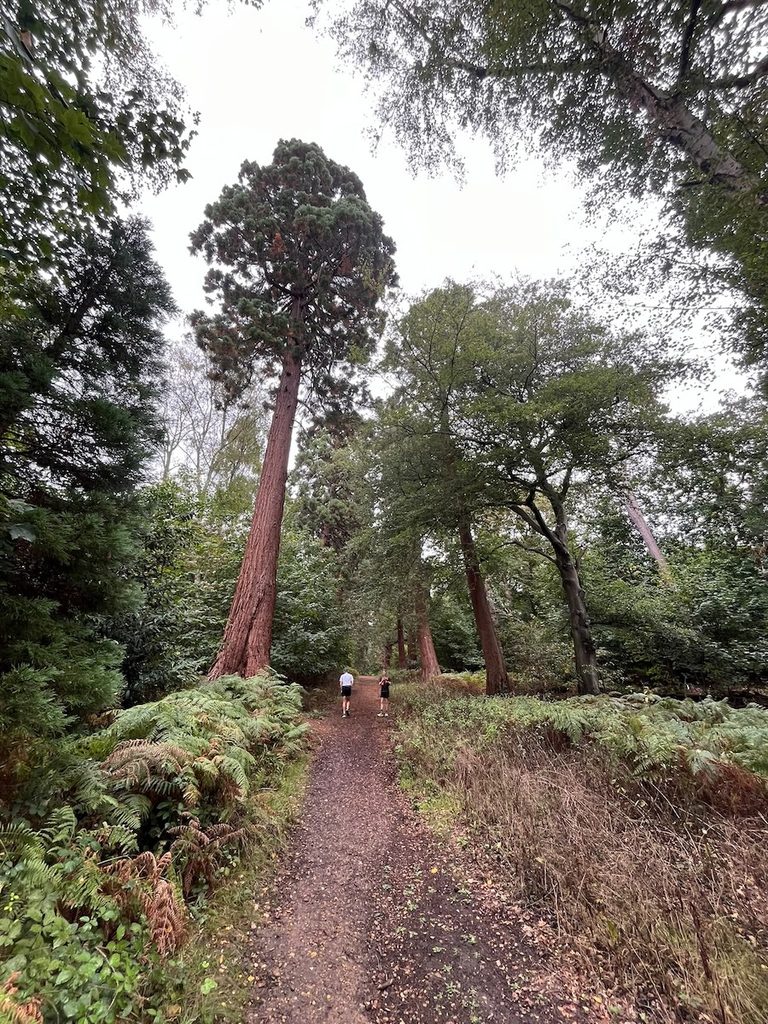
In Havering-atte-Bower we stop for a loo break at a pub. The landlady kindly refills my ice bandana. Even though it’s mild out, the feeling of cold water against my skin is hugely refreshing. This spurs me on for a few miles into Harold Wood, where Emily joins us for the final half marathon. It’s a relief to see her, but I have to hold back the emotion and focus on the task at hand. I am a gossamer net holding back a landslide.
At Upminster, a familiar face: the incumbent record holder, David Bone, joins us for the last push. He seems to understand the headspace I’m in and doesn’t say too much. It’s an honour to have him. I lie down again for two minutes in Ingrebourne Country Park, the last green space on the Loop, and then before I know it we’re at Rainham station. Andy and Aurime join us for the final five miles along the Thames.
My only regret for this run is that I was not as jubilant as I should have been for the final stretch. Spirits are high amongst the pacers, but I retreat within myself, trying to hold it together. The wide estuary and industrial landscape makes for a dramatic finish. Erith, all those miles ago, is visible across the water. And all I can think about is how much pain I am in.
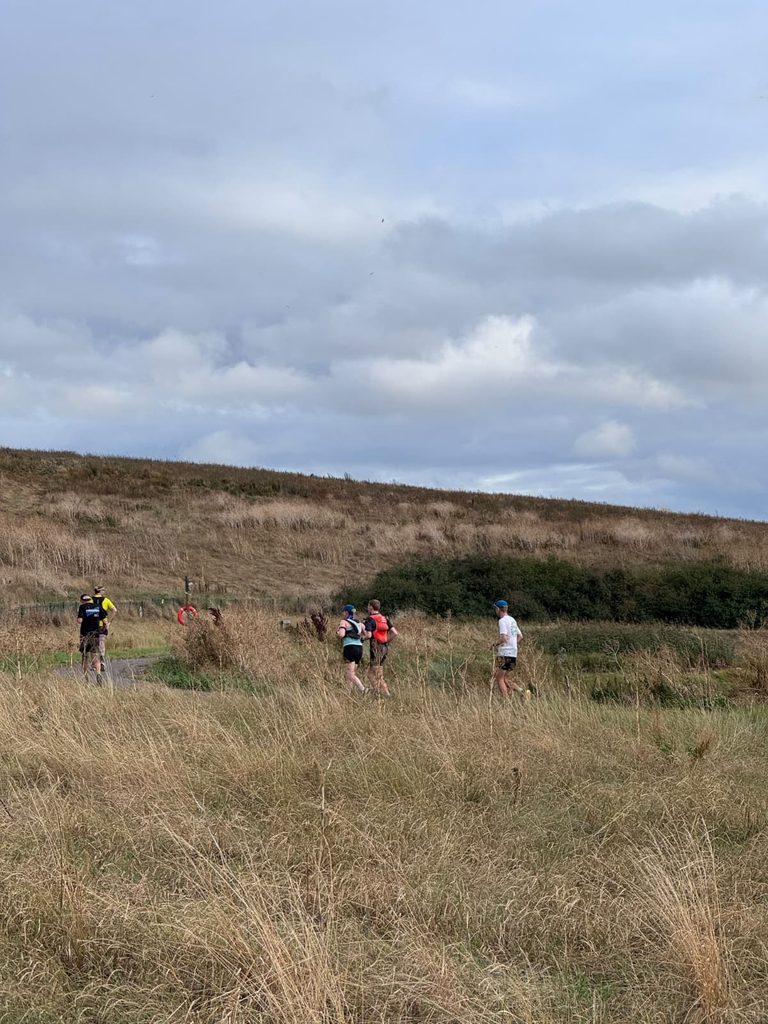
Maths. A glance at my watch with 5km to go tells me I have 40 minutes to break 33 hours. That sounds achievable, but by this point my running pace is almost a walk. Maths uses the brain, the brain uses energy. Stop doing maths. I start to sigh with every step, then moan, then grunt. A section of trail is flooded with sewage. We plough through it. It stinks. This sucks, I hate it, and I want it to stop.
And then, we hit the road. A sign says ‘Purfleet – ½ mile’. And my pace begins to lift from a hobble, to a jog, to a run. The station yawns into view. My pacers are cheering, some men in hi-vis watch on. I touch the station and it’s over. My watch says 32:56:57.
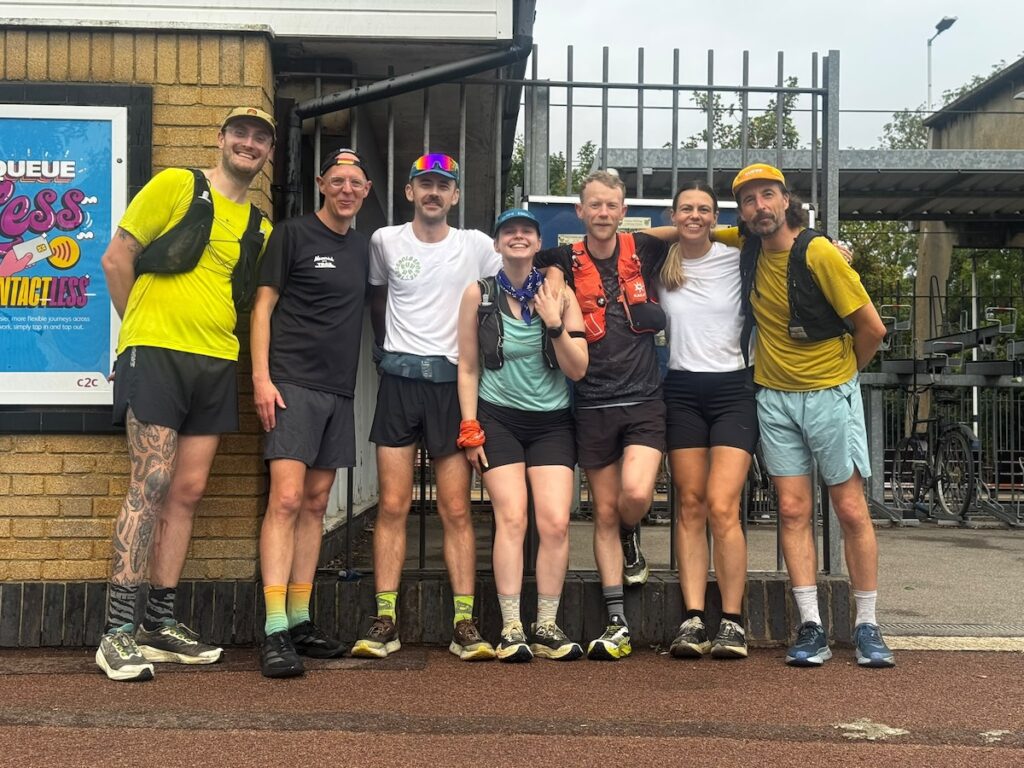
Someone hands me some prosecco. Someone else suggests I drink it out of my filthy shoe. We hover for a few minutes. It’s a big moment, but it’s also just another place. Endings are like that. The warm glow of my achievement is offset by the pain in my legs. Slowly the atmosphere dissipates and people take their leave. It takes a monumental effort to walk twenty metres to Andy’s car. He kindly drives us home, essentially carries me up the stairs to my flat. I stoop in the shower like a statue and collapse on the sofa. Emily has put something on the TV and handed me a protein shake. I get a bit confused, but I know I don’t have to run anymore.
Savvy readers may have clocked that the London Loop doesn’t finish where it starts, which means it isn’t actually a loop. The ‘Loop’ in London Loop is in fact an acronym; it stands for London Outer Orbital Path. (Which means, technically, the London Loop’s full title is, rather awkwardly, ‘The London London Outer Orbital Path’.)
In completing this run I was struck by a simple but powerful idea: why don’t all cities have an Outer Orbital Path of their own? In fact, why don’t we make it a requirement of cities that a border path is waymarked for residents to enjoy?
It could be great: the Birmingham Boop, the Manchester Moop, the Portsmouth… Well, perhaps we can come up with a different naming convention. The point is, urban border paths like the London Loop provide something that many long-distance waymarked routes cannot – accessibility. As a resource for improving the physical, mental, and spiritual well-being of its citizens, the London Loop is unrivalled: over 15 million people live within an hour’s journey of it, on public transport. And yet, hardly anybody has heard of it. Why not?
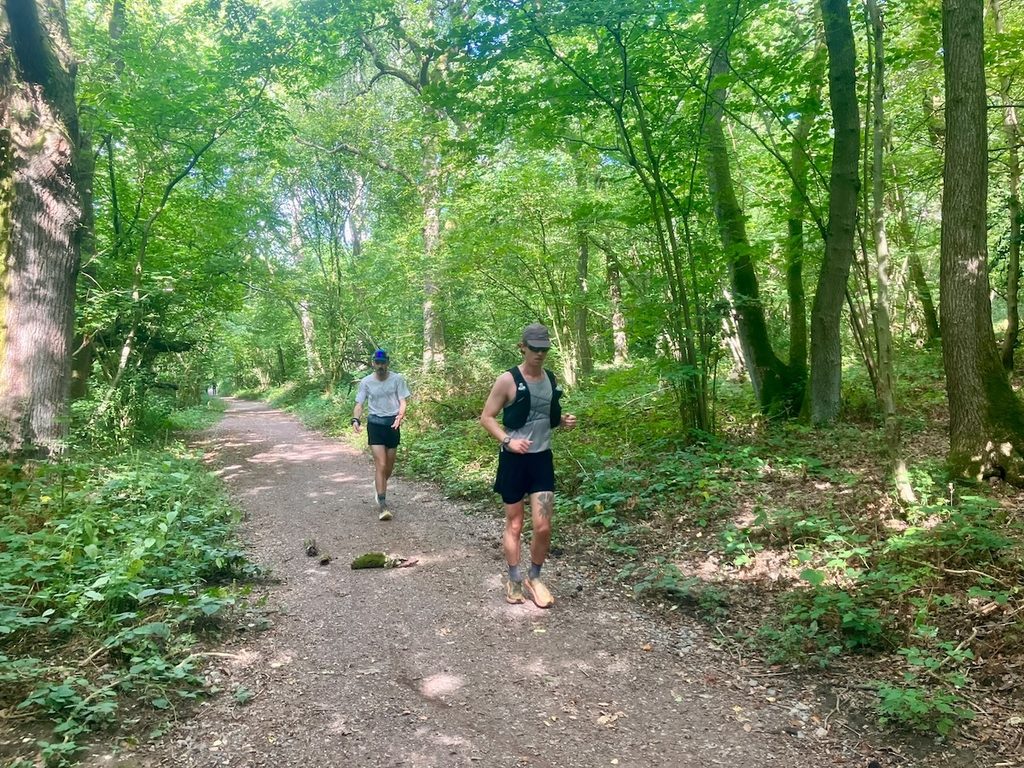
I think it’s got something to do with the fetishisation of ‘nature’, as an abstract concept rather than a living, embodied reality. The concept of the ‘great outdoors’ positions the natural world as something that is inherently far removed from urban life, implicitly suggesting that the only way city-dwellers can ‘truly’ experience nature is to travel a great distance.
The reality is that England is a small, densely populated place, and its landscape has been deeply affected by the activity of people over thousands of years. There are very few places – perhaps none – where nature sits untouched by humanity in this country. Even the “clouded hills” of Wordsworth’s Lake District – surely the archetypal English natural landscape – have in fact long been stripped bare of their natural woodlands to accommodate the needs of agriculture.
I am all for conservation and the restoration of natural landscapes. It’s a tragedy that England’s forest coverage, at 12%, lags behind the rest of Europe. But at the same time, I strive to be a pragmatist. The reality is that most people live in urban environments. If you can get people to engage with and care about the natural world on the doorstep, maybe then they’ll start to care more about the environment more generally.
Ultrarunners, too, idealise far-off places, travelling through deserts or across mountain ranges to get our fix. But if there’s one thing I learned running the Loop, it’s that the sense of adventure we’re seeking has less to do with the landscapes we move through and a lot more to do with the way in which we’re moving.
This wasn’t a race – there was no medal, no T-shirt, no points earned to qualify me for a pyramid scheme. But it meant so much more than any race I’ve ever run. 23 friends, new and old, helped me, at some point, break this record; I spent months planning, recceing, thinking deeply about the challenge; I learned about the landscape and history of the city I call home and found myself exploring strange, unfamiliar places a few miles from my front door. In the end, this experience will stay with me far longer than any bib.